There is a particular kind of decision that separates organisations that grow well from organisations that simply grow. It is the decision about where to locate a workforce for the next decade, not the next quarter. In Pune, that decision is quietly being re-made, and the direction of travel is unmistakably eastward.
This is not a story about a single building or a single deal. It is a story about where capital, talent, and infrastructure are converging, and why the occupiers who read the signals early will hold a structural advantage over those who follow the crowd.
Pune is no longer the understudy
For years, Pune was discussed as the sensible alternative to Bengaluru: cheaper, calmer, competent. That framing is now out of date.
In 2025, India’s office market recorded its strongest year on record, with net absorption reaching roughly 57 million square feet, a figure that points unambiguously to headcount and footprint expansion rather than consolidation. Pune was among the cities that posted its best-ever annual net absorption in that cycle, according to JLL’s market data. The city now holds close to 12 percent of Grade A office stock across India’s top six markets, somewhere in the region of roughly 120 million square feet as of mid-2025.
The deeper shift is in what Pune now is. The city has moved decisively beyond its “manufacturing-plus-IT” reputation to become one of India’s most important multi-industry capability hubs. It hosts more than 360 Global Capability Centres today, up from roughly 210 in 2019, and credible projections place it on a path toward 500 or more by the end of the decade. Maharashtra’s GCC Policy of 2025 has added formal momentum to what was already organic growth.
For an enterprise occupier, three facts matter most. Pune offers engineering and analytics talent of genuine global standard. It delivers cost efficiencies estimated at 20 to 25 percent against Bengaluru. And its attrition (hovering around 14 percent) is among the most stable in the country. Talent that is skilled, affordable, and inclined to stay is the rarest combination in Indian real estate planning. Pune has it.
The east has already won the first act
Within Pune, the centre of gravity has shifted east, and the data is not subtle about it.
The Secondary Business District East, the corridor that runs through Kharadi and its surroundings, has become the engine of the city’s commercial activity. In the first quarter of 2025 alone, SBD East accounted for roughly 1.1 million square feet of net absorption, close to 45 percent of all office take-up in Pune, on the back of high-value deals from BFSI, IT, and flexible-workspace operators. That same quarter saw Pune post a historic leasing high of around around 3.5 million square feet, led predominantly by the east, per Cushman & Wakefield’s reporting.
Crucially, this demand has held its pricing. Even as new supply entered the market, average rentals across SBD East stayed firm at ~₹99 per square foot per month; a clear signal that occupier confidence in the corridor is structural, not speculative. When rents hold through a supply wave, it tells you the demand is real.
So the first act is settled. The east is where serious occupiers want to be. The interesting question is what happens next.
The saturation problem nobody wants to name
Success creates its own constraints. As Kharadi and Viman Nagar matured into Pune’s premier addresses, two things happened in parallel: availability tightened and pricing climbed. Vacancy across these prime micro-markets is now expected to remain stable-to-tight, and the most sought-after corridors are approaching the point where large, contiguous, campus-scale requirements become genuinely difficult to satisfy.
For an organisation looking to lease 20,000, 50,000, or 100,000 square feet in a single, coherent footprint, with room to expand, the established east is increasingly a market of compromises. You can have the address, or you can have the scale and the economics. You can rarely have all three.
This is the precise moment in any market cycle when the smart money stops asking “where is everyone now?” and starts asking “where is everyone going to be?”
Following the infrastructure, not the herd
The most reliable predictor of where commercial value accrues is not where demand sits today. It is where the public infrastructure is being committed. On that measure, the signal is pointing further east along the Nagar Road corridor, towards Wagholi.
In June 2025, the Union Cabinet approved roughly ~₹3,626 crore for Phase 2 of the Pune Metro, including Corridor 2B: an extension of the existing Blue Line from Ramwadi to Wagholi. The corridor runs close to 11.6 kilometres along Nagar Road, adds eleven stations, and is explicitly designed to serve the residential, commercial, and IT clusters strung along that axis. It will plug into the wider network at the District Court interchange, connecting eastward occupiers to Hinjewadi, Swargate, and the rest of the city through a genuinely multimodal system. Global construction tenders for the corridor were already in motion by early 2026.
Layered on top of this is the proposed Pune Inner Ring Road, a connectivity project repeatedly identified as a potential game-changer for Wagholi and the eastern suburbs, easing the movement of people between the highways, the IT hubs, and the fast-growing residential belt that houses the workforce.
The pattern here is the one that has rewarded patient occupiers in every Indian metro: rapid-transit and arterial road investment lands first, and Grade A commercial value follows. Areas along operational and upcoming metro corridors consistently see demand and pricing strengthen as access improves. The Nagar Road-Wagholi corridor is currently in the window between the infrastructure commitment and the price re-rating. That window does not stay open indefinitely.
What the smart money is actually buying
The thesis is not “go east because it is cheaper.” Cost arbitrage alone is a weak reason to make a decade-long location decision. The occupiers reading this market correctly are buying four things at once:
Scale without compromise. Large, efficient floor plates in a single campus, with the structural runway to expand as headcount grows, rather than fragmenting across buildings or relocating again in three years.
Position ahead of the curve. A foothold on the corridor before the metro becomes operational and before pricing fully reflects the connectivity, rather than paying the premium after the fact.
Fundamentals that hold up. Grade A building systems, sustainability credentials, power and parking redundancy, and operational readiness, the unglamorous specifications that determine whether a workplace runs smoothly for ten years or becomes a recurring problem.
An ecosystem that earns retention. In a market where attrition is the quiet tax on every growth plan, the quality of the workplace environment is no longer a soft benefit. It is a hard lever on talent economics.
Where the thesis points
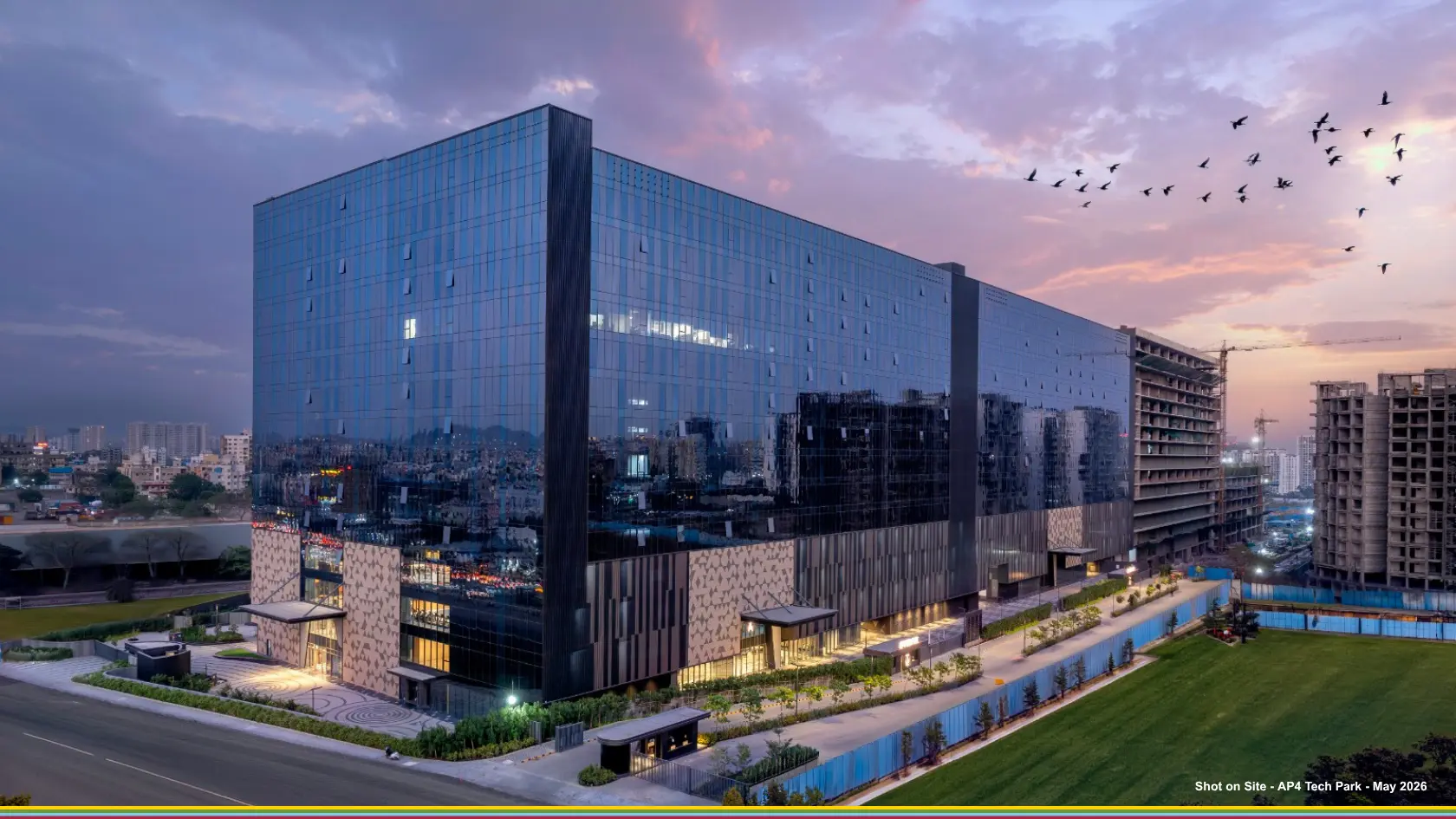
This is the context in which AP4 Tech Park sits. A 17+ acre Grade A campus on Pune-Nagar Road in Wagholi, on the very corridor the Metro Phase 2 extension is being built to serve, it is designed around exactly the criteria a forward-looking occupier evaluates: large floor plates, IGBC Platinum pre-certification, WiredScore Platinum certification, enterprise-grade building systems, and a full campus ecosystem of amenities, delivered as warm shell and ready for fitout. Phase 1, comprising Wings A and B, is now available for leasing.
We did not design AP4 to chase the market east. We built it because the fundamentals were already pointing there; and because the organisations that move with conviction, rather than consensus, tend to be the ones still ahead a decade later.
The east has already proven the demand. The infrastructure is now committing the future. The only open question is who positions early enough to benefit from both.
To discuss availability, specifications, and commercial terms for AP4 Tech Park, request a callback at a time that suits you.